Wiatreo presents the new GEOMET-500 test bench for car workshops

9 November 2026
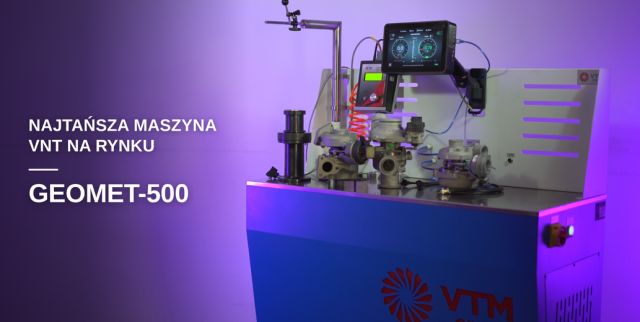
To make an informed decision about remanufacturing a turbocharger and to verify its settings after a repair, a workshop needs objective data on how the variable geometry works. Wiatreo presents the GEOMET-500 - a new, more affordable test bench from the Ukrainian manufacturer VTM Group that allows workshops to check and adjust this mechanism themselves. Wiatreo specialists continuously expand the database of reference parameters with new turbochargers and advise workshops on how to apply them.
What to check before sending a turbocharger for repair
A loss of power and unusual noises may point to a turbocharger fault, but the problem does not always lie with the turbocharger itself. The turbo is removed, sent for remanufacturing and refitted, yet the problem remains unsolved. The cause of the fault has still not been found, although the customer has already paid for the repair.
For this reason, before removing the turbocharger, check:
- the fuel system - the operation of the injectors and the fuel pump;
- the intake tract and the boost system - the tightness of the connections and any possible air leaks;
- the exhaust tract and the EGR system - the condition of the DPF particulate filter, the flow through the exhaust and the operation of the exhaust gas recirculation valve;
- the lubrication system - oil pressure and oil supply, and the condition of the oil pump.
Garrett Motion and BorgWarner likewise recommend first establishing the cause of the fault and only then deciding on a turbocharger replacement.
If the turbocharger has already been removed, check the operation of the variable geometry on the GEOMET-500 test bench. The measurements will show whether there are deviations in the operation of the mechanism. Based on the test results and a visual inspection, the technician determines whether an adjustment is sufficient or a repair is required. The remaining turbocharger assemblies are checked separately, independently of the bench readings.
How to confirm that the geometry has been adjusted correctly after a turbo repair
After remanufacturing, a workshop can either obtain a warranty from a partner service or check the turbocharger itself before handing it over to the customer - the position of the variable geometry stops, the length of the actuator rod and the actual air flow.
On the GEOMET-500 bench, the technician compares the measured values with the reference values for the specific model. Where deviations occur, the end-position stops of the geometry vanes or the length of the actuator rod are adjusted directly on the bench. The readings update in real time, which makes it possible to control the result of the adjustment within factory tolerances.
If the workshop provides a warranty on the repair, the test results are worth keeping together with the documentation of the work performed. The GEOMET-500 does not produce a printed report. The technician can enter the turbocharger number, the date, the values obtained and the adjustments carried out into the work order. In the event of a warranty claim, the workshop will have data on the results of the geometry check at the moment the unit was handed over.
Which tests the GEOMET-500 performs and how the results are assessed
The GEOMET-500 measures the air flow through the nozzle ring of the turbocharger at different positions of the variable geometry vanes. Before the measurements, the technician checks the free movement of the vanes and the tightness of the connections to the bench. A sticking mechanism and air leaks can distort the test results.
To assess the condition of the mechanism, the bench performs three tests:
- Check with the geometry fully closed - the air flow is measured with the vanes fully closed.
- Check across the entire range of movement - from fully closed to fully open. The bench plots a graph showing the actual air flow at every point of the mechanism's travel.
- Check of the unison ring play in the variable geometry - a separate test that helps determine the degree of wear of the mechanism components.
If the readings fall outside the tolerance, the technician checks the setting of the stops and the operation of the actuator. If the mechanism is worn or damaged, adjustment alone is not enough. The operator can run the tests automatically or control them manually, stopping the check at any required stage.
The GEOMET-500 uses the same database of turbocharger reference parameters as the GEOMET-2000, covering more than 8,000 references. For the test, the technician selects the reference for the specific turbocharger variant with the corresponding factory parameters. During the measurements, the system automatically accounts for atmospheric pressure and temperature.
Wiatreo specialists continuously add the parameters of new turbochargers to which the company has direct access. When working with rare models, or where the required reference is missing, customers can contact Wiatreo for technical data and assistance in determining the parameters for the test.
What a workshop needs in order to work with the GEOMET-500
To install the GEOMET-500 bench in a workshop, a workstation with a single-phase 230 V supply is sufficient. Air is supplied by a built-in side-channel blower and the vacuum is created by a vacuum pump, so no external compressor or air receiver is required. A filter protects the flow meter from contamination and can be cleaned in-house if needed. The power consumption of the bench is 1.5 kW. The dimensions of the unit are 1,100 × 520 × 1,450 mm and its weight is 160 kg. A level, solid workshop floor is required for installation.
The turbocharger is mounted vertically using a magnetic adapter. Fitting takes about 10 seconds. For housings made of non-magnetic materials, an additional support element is provided. The open working area gives access to the unit during adjustment, including when working with large turbochargers. The set includes a kit of mounting adapters and a digital indicator for measuring the travel of the actuator rod.
The GEOMET-500 also makes it possible to test used turbochargers. In a static test the rotor does not turn, so there is no need to connect an oil supply to the cartridge. The cycle for adjusting the variable geometry of a turbocharger takes less than five minutes. The bench itself can be calibrated by the operator in about 10 seconds, without involving a service engineer.
The bench works with vacuum and pneumatic actuators, including those with a position sensor. For such actuators, the system reads the feedback signal from the potentiometer. For a full test of turbochargers with electronically controlled geometry, a compatible tester from VTM Group is required:
- ATP-1000 - a tester for electronic actuators on passenger cars and light commercial vehicles with 12-volt systems. It checks the drive motor and the position sensors. Price - from €2,500 net.
- ATP-3000 - a tester and programmer for the same vehicle categories. In addition to diagnostics, it supports saving and loading the firmware of compatible electronic actuators. Price - from €3,000 net.
The choice of tester depends on the model and type of actuator. N75 boost control valves, however, are tested by the bench on its own, across the entire vacuum range, without connecting an ATP-1000 or ATP-3000.
How a workshop can earn money with the GEOMET-500 by testing turbochargers
Over the past two years, at the Autotechnika Warsaw, Autoparts Warsaw, TTM 2026 and Automechanika Frankfurt 2026 trade fairs, Wiatreo specialists have repeatedly discussed with workshop owners the opportunity to open their own turbocharger service line. The main obstacle for smaller workshops remained the cost of specialised equipment. The GEOMET-500 makes it possible to start with testing and adjusting the variable geometry, without investing in a full turbocharger remanufacturing setup. If a workshop uses ready-made, tested CHRA cartridges, the technician can adjust the variable geometry on the GEOMET-500 after replacing them.
A workshop can add a new service to its price list: testing a removed turbocharger. After the diagnosis, the workshop either refits the calibrated unit to the car or recommends a repair. In Poland, such a test costs 150–250 zloty on average.
Wiatreo supplies the GEOMET-500 set with an ATP-1000 tester for €11,000 net, which is about 47,300 zloty. An operating lease can be an alternative to paying for the equipment in one instalment. With a 10% down payment and a 24-month term, the indicative monthly payment is approximately 1,645 zloty net*.
*Note. In Poland, a 24-month lease calculation applies at a depreciation rate of 20%. At a rate of 14%, the minimum term is 35 months. The applicable rate should be confirmed with your accountant.
At a test price of 150–250 zloty net, the revenue from 7–11 orders a month covers the lease payment of 1,645 zloty net. That is one test every 2–3 working days on average. And this concerns diagnostics alone. Turbocharger repair can generate additional revenue, while performing part of the work in-house reduces subcontractor costs. When calculating net profit, the cost of carrying out the tests still has to be taken into account.
How the GEOMET-500 helps speed up turbocharger remanufacturing
Large workshops specialising in turbocharger repair are in most cases already working with expensive benches - TurboTest from CIMAT and GEOBOOST-7000 from VTM Group. Preparing and testing a single turbocharger takes 30–90 minutes. A significant part of that time goes on mounting.
The GEOMET-500 makes it possible to move the testing and adjustment of the variable geometry to a separate station. The bench does not check the actual boost pressure or oil leaks with the rotor spinning. Dynamic equipment is still required for such tests. The main equipment remains free for dynamic testing, and the workshop can handle more turbochargers without purchasing another expensive system. At the same time, the customer does not overpay for additional workshop work.
How to order the GEOMET-500 and arrange training from Wiatreo
Wiatreo supplies the GEOMET-500 to order. The delivery time is 120 days. When purchasing the bench, the customer receives one day of free training at the Wiatreo office in Opole, Poland. During the first three months, company specialists provide free advice on setting up the equipment, working with the bench and testing turbochargers.
To order a GEOMET-500, tell the Wiatreo specialists which turbochargers and actuators your workshop works with. We will help you determine the configuration you need, including the choice between the ATP-1000 and ATP-3000 testers for electronic actuators, and prepare an offer with the price and delivery terms.
Contact us by phone at +48 508 115 327 or write to office@wiatreo.pl.
Comments
Log in to leave a comment