Great company ready to work locally. Representative office professionals from Ukraine are the best mechanics, driving a turbine from the representative office on Koras will give the car a lot! High class professionals.













Why customers choose Wiatreo
About usWIATREO.PL is a fast-growing brand offering comprehensive services in turbocharger sales, parts replacement and turbocharger remanufacturing.
Wide product selection We work with leading manufacturers to offer our customers the best products on the market.
Warranty on all parts We give our customers confidence that they are receiving high-quality products backed by a reliable warranty.
Professional service Our qualified team has extensive experience and expertise in turbochargers and related parts.
Customer reviews
A very professional company. It helped me solve the problem. Super immediate shipment. The next day Koras was at my office. Professional help from an expert and they answer the phone. I recommend!
Great company! Very quick contact. The gentleman who answered the phone was very helpful. The parts work flawlessly. I highly recommend!
REVELATION! After the painful experience of assembling Chinese parts and reworking the same turbine three times, I found this company. They advised me what to do, sent high-quality parts and gave a workshop discount! A company worth recommending!
Frequent questions
Ask a questionNews
All news
Contacts
- Phone
- +48 508 115 327
- office@wiatreo.pl
- Warehouse
- Wiatreo.pl Sp. z o.o., ul. Cygana 3, 45-121 Opole, Poland Mon–Fri 8:00–17:00
Location Wiatreo.pl Sp. z o.o., ul. Cygana 3, 45-121 Opole, Poland
Open map
Turbo suppliers Wiatreo
Turbine repair is performed after precise hardware diagnostics and performance testing under load. At Wiatreo, turbocharger repair includes cartridge replacement or refurbishment, shaft balancing, variable geometry adjustment, and testing of the unit on high-speed balancing and geometry adjustment rigs.
Professional turbocharger diagnostics and restoration are performed for passenger cars, commercial vehicles, turbodiesels, and high-power diesel engines, including turbochargers with electronic actuators and variable geometry systems. Following diagnostics, the nature of the damage is determined, the scope of work is agreed upon, and the turbocharger's performance is restored with a final check of the stated specifications.
What symptoms indicate a turbocharger requires regeneration?
In most cases, a decrease in system efficiency begins after cartridge overheating, obstruction of oil drainage, increased axial or radial rotor play, or wear of the variable geometry mechanism. For modern diesel engines, turbocharger repair is necessary at the first sign of deviations in operating parameters. Such symptoms are particularly common in Audi 2.0 TDI, BMW N47, Mercedes-Benz OM651 engines, as well as in 1.6 HDI and 2.0 BiTDI systems, where the turbocharger operates under high thermal and mechanical loads even at low engine speeds.
The most common signs that indicate a need for turbocharger repair include:
-
loss of thrust after the engine reaches load;
-
slow buildup of boost pressure during acceleration;
-
power dips after gear shifts;
-
whistling or metallic noise from the turbine at high speeds;
-
vibration in the active boost range;
-
overboost/underboost errors, boost pressure deviations, and engine power limitation;
-
Engine limp mode after acceleration;
-
Black smoke during rapid acceleration;
-
Blue smoke after prolonged load;
-
Oil in the intake tract, boost pipes, or intercooler;
-
Variable geometry operation is unstable;
-
Electronic actuator malfunctions;
-
Increased oil consumption without visible leaks.
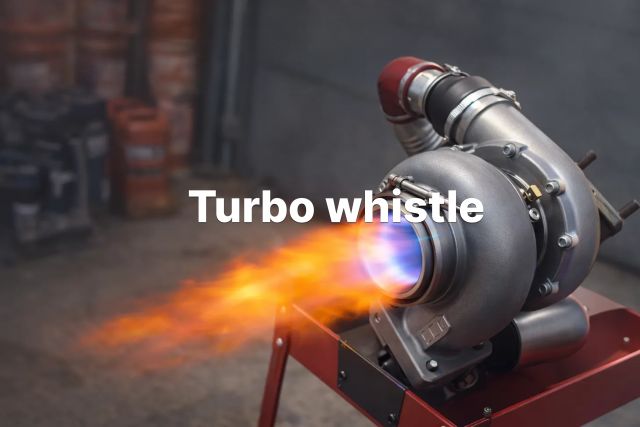
Turbine whistling at high RPMs often occurs after increased axial or radial rotor play. With continued operation, vibration begins to worsen the imbalance and accelerates bearing wear. In such cases, hardware diagnostics of the turbine can determine the condition of the rotor, cartridge, geometry mechanism, and the degree of wear of the turbocharger's operating components.
How does professional turbocharger regeneration work?
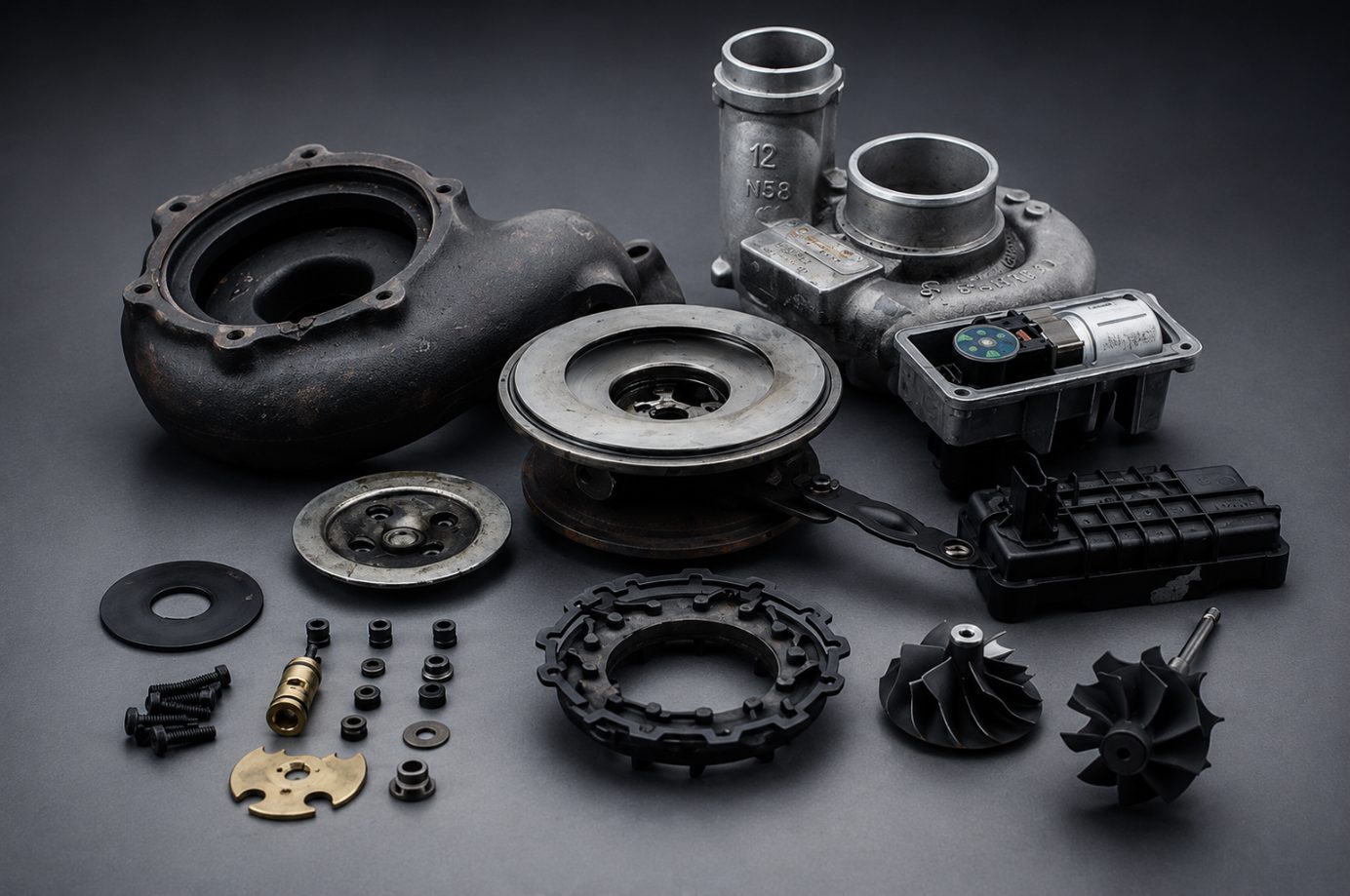
At Wiatreo, turbocharger repair is performed in stages, starting with troubleshooting and disassembly of the unit, finishing with VSR rotor balancing and a final performance test under load. For modern bi-turbo and twin-turbo systems, simply replacing the cartridge or seals without further geometry adjustment, actuator testing, and boost pressure monitoring under engine operating conditions is not enough.
Turbocharger Diagnostics and Disassembly
Diagnosing BMW N47, Audi 1.9 TDI, and OM651 commercial diesel engines often reveals hidden damage to the geometry and bearing assembly that cannot be identified without complete disassembly and rotor testing on a test bench.
During diesel engine turbocharger diagnostics, Wiatreo checks:
-
casing and hot-scroll seal tightness;
-
rotor and CHRA condition;
-
compressor wheel and rotor shaft wear;
-
plain bearing condition;
-
signs of hot-end overheating;
-
Mounting surface geometry;
-
VNT/VGT adjustment range;
-
correct operation of the electronic actuator.
For turbochargers with VNT/VGT and electronic actuators, the cost of turbo diagnostics is usually higher due to the need to completely disassemble the geometry mechanism and inspect the control components.
Cleaning
Chemical and ultrasonic cleaning removes dense oil deposits, overheating products, and carbon deposits. Professional alkaline and degreasing compounds are used to dissolve oxidized oil deposits without damaging the turbocharger's working surfaces.
Replacing worn parts and cartridges
For repairs according to customer specifications, we use original components or parts from TURBOCENTRAS UAB, a Lithuanian manufacturer of turbochargers and turbine regeneration parts. Wiatreo is the brand's official representative in Poland, supplying repair kits for Garrett GTC/GTA, BorgWarner BV43/BV50/GTB, Holset, Mitsubishi, and IHI Turbo turbochargers. These components are manufactured using heat-resistant alloys and Japanese steel with a nickel content of up to 52-58%, designed to withstand continuous operation at temperatures up to 800°C and high mechanical loads.
Turbine Balancing and Tuning after Repair
The assembled turbocharger undergoes high-speed VSR rotor balancing on a GEOMET-2000 system. The turbine is tested on the rig at speeds up to 250,000 rpm, a range that closely approximates the actual operating conditions of modern turbochargers. At this speed, even a rotor misalignment of just a few microns begins to increase the load on the shaft, plain bearings, and the oil film inside the CHRA. The GEOMET-2000 system detects residual vibration and rotor microimbalance even before the turbocharger is installed on the engine.
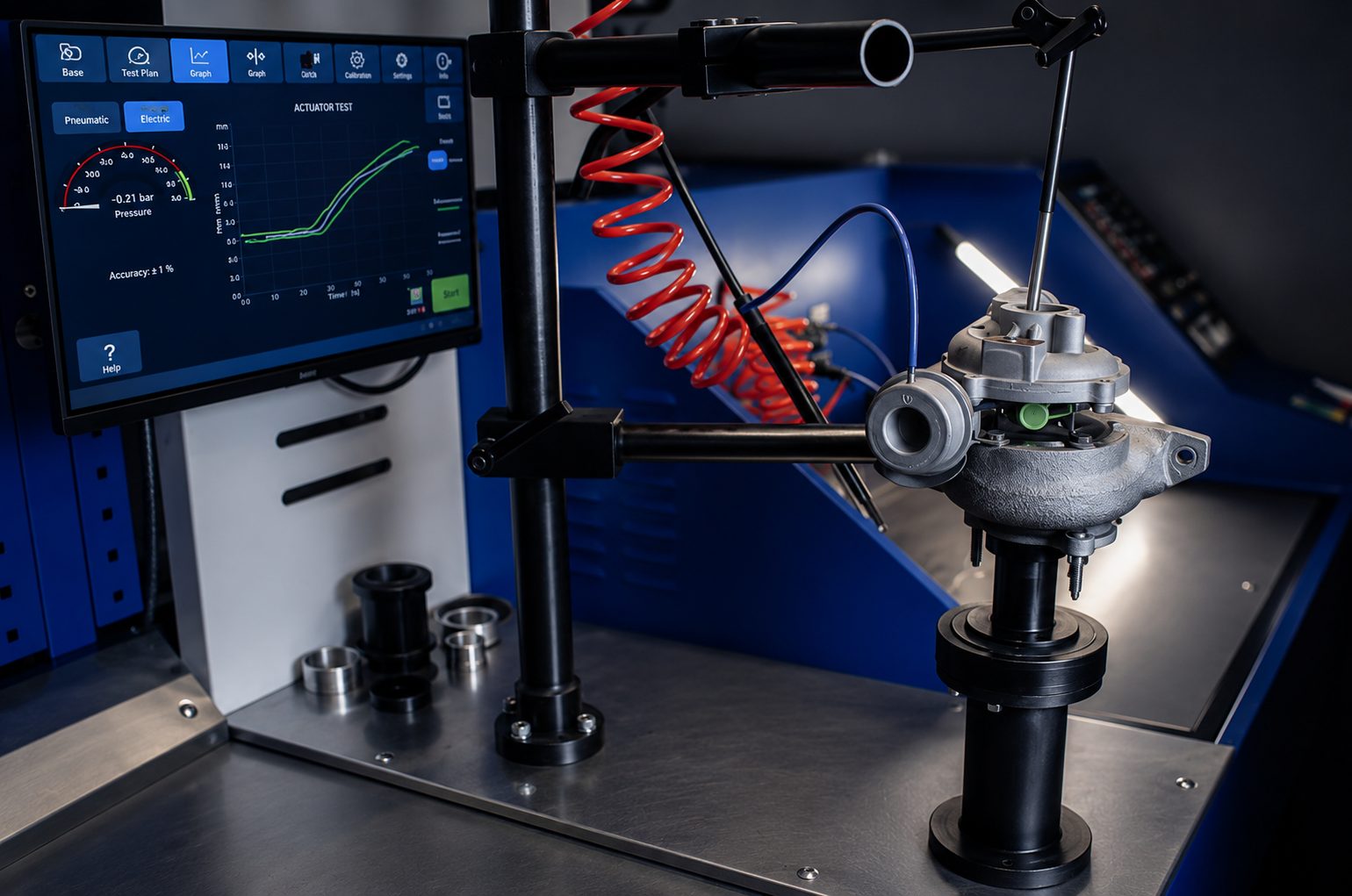
Following VSR balancing, the variable geometry is adjusted and the electronic actuator is calibrated. Geometry tuning includes checking the blade opening range, geometry response under load, and actual boost pressure in various modes.
Final Testing after Regeneration
Before installation or shipment to the customer, the turbocharger unit undergoes a final inspection. The rotor's stability, geometry adjustment, and turbocharger response across the load range are monitored—this is what differentiates professional turbo restoration from standard repair. For modern turbos, cartridge replacement without VSR balancing and geometry adjustment is insufficient to properly restore the unit's operating parameters.
Why does a turbo fail?
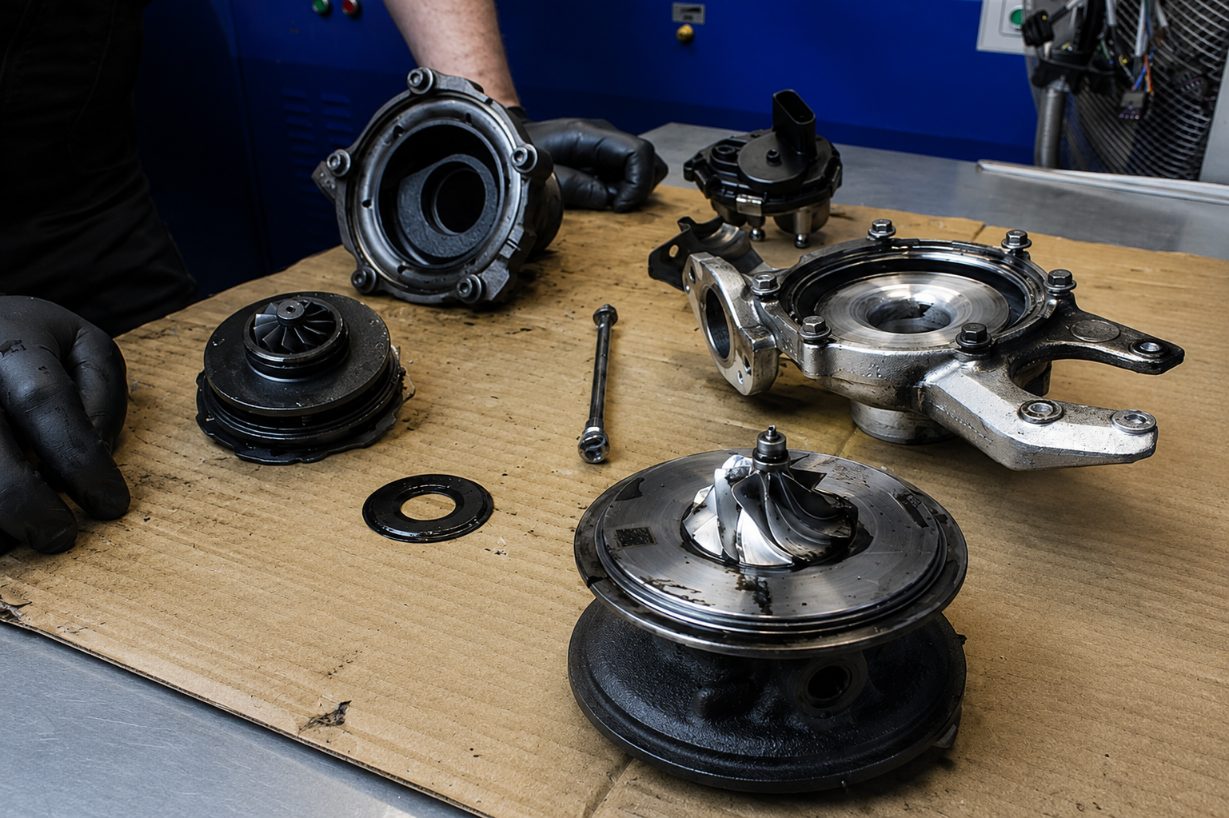
From over 20 years of Wiatreo's experience, most turbocharger failures are not due to rotor wear, but to improper operating conditions:
-
oil overheating;
-
DPF contamination;
-
air leakage after the air flow meter;
-
unstable EGR system operation.
In practice, the company's service center most often receives turbochargers after operation with a leaky intake, contaminated oil system, or prolonged driving with boost pressure fluctuations. In EcoBoost gasoline turbocharged engines, additional risk factors include oil overheating after heavy loads and shortened service intervals, which accelerate wear of the bearing assembly and CHRA.
How does professional turbocharger regeneration differ from basic remanufacturing?
|
Stage |
Basic remanufacturing |
Professional turbocharger remanufacturing |
|
Diagnostics |
Visual inspection, play check, and condition of key components |
Hardware diagnostics of the CHRA, rotor, VNT/VGT, actuator, and turbine operating parameters |
|
Unit cleaning |
Mechanical cleaning and basic chemical treatment of the housing and hot end |
Chemical and ultrasonic cleaning of the CHRA, geometry, hot end, and mounting surfaces |
|
Part replacement |
Replacement of key worn components |
Part selection based on exhaust gas temperature, load, and CHRA parameters |
|
Balancing |
Rotor balancing at standard speeds |
High-speed VSR balancing on a GEOMET-2000 |
|
Geometry adjustment |
Basic mechanical adjustment |
Calibration of the VNT/VGT and electronic actuator for the operating parameters of a specific engine model Auto |
|
Turbocharger Repair Check |
Leakage Check and Basic Unit Performance |
Check Boost Pressure, Geometry Response, and Operating Parameters Check under Load |
|
Results after Remanufacturing |
Restoring the turbocharger's basic performance depends on the condition of the unit and the precision of the repair. |
Reduced risk of turbocharger failure after installation on the engine, 1-year warranty |
What's more cost-effective: turbocharger remanufacturing or buying a new one?
For most models, professional turbocharger repair is more cost-effective than buying a new unit if the housing, hot end, and CHRA mounting surfaces remain intact and free of mechanical damage. At Wiatreo, remanufacturing of Garrett, BorgWarner, Holset, Mitsubishi, and other VNT/VGT turbochargers includes VSR balancing, geometry adjustment, and performance testing under load, making the final cost of remanufacturing typically significantly lower than replacing the turbocharger with a new one. Purchasing a new turbine is cost-effective when the rotor is completely worn out, if cracks appear on the hot snail, if the housing is deformed, or after critical oil starvation of the engine.
What determines the cost of turbocharger repair?
The cost of turbocharger repair depends on the turbocharger design type, the extent of damage, and the number of parts to be replaced. The price is also affected by the vehicle class: a turbocharger cartridge for a premium car, such as a Mercedes or BMW, will be significantly more expensive than a turbocharger cartridge for a Renault or Opel.
The cost of regenerating the unit depends on the following factors:
-
Turbine type—wastegate or VNT/VGT;
-
the presence of an electronic actuator;
-
the condition of the CHRA, rotor, and compressor wheel;
-
hot end overheating and housing deformation;
-
damage to the mounting surfaces;
-
the need for VSR balancing;
-
geometry adjustment and actuator calibration;
-
damage due to oil starvation;
-
the design of the boost system and the turbocharger model.
When regenerating diesel turbochargers, Wiatreo always replaces the variable geometry mechanism (VNT/VGT). We believe that for a reliable turbocharger rebuild, this component must be replaced, as it operates at high temperatures and directly impacts the correct boost pressure.
The average cost of rebuilding a diesel turbocharger is between 1,100 and 1,400 PLN gross. This price includes replacement of the cartridge (CHRA) and geometry mechanism, provided that the housing and other key turbocharger components are in good condition.
For gasoline turbochargers, the average cost of rebuilding is between 900 and 1,200 PLN gross. However, the final price is always determined individually and depends on the turbo model, the nature of the damage, and the scope of work required.
For Garrett, BorgWarner, Holset, Mitsubishi, and other turbochargers with variable geometry systems, the cost of rebuilding the turbocharger is usually higher due to the more complex VNT/VGT calibration, actuator adjustment, and performance monitoring after VSR balancing.
Professional Turbocharger Repair and Diagnostics in Poland
Currently, Wiatreo regenerates an average of 40-50 turbochargers per month. We deliberately avoid large-scale orders, as our priority is the quality of the remanufacturing and meticulous control of each repair stage. This approach allows us to devote maximum attention to each turbocharger, ensuring high-precision diagnostics, remanufacturing, and final testing.
We are trusted by both private car owners and professional automotive market participants. Our regular customers include local auto repair shops and service centers, transport and logistics companies, including GTV Bus, and authorized service centers such as ONE Group. Our long-standing partnerships with corporate clients confirm the high quality of our work, timely delivery, and reliability of our remanufactured turbochargers.
Wiatreo specializes in professional turbocharger remanufacturing for passenger cars, commercial vehicles, tractors, and special equipment. The service center regularly receives turbochargers from Audi, BMW, Mercedes-Benz, Volkswagen, Toyota, Ford, Renault, as well as MAN, DAF, Scania, Volvo, Iveco, and other truck brands.
The Wiatreo Turbocharger Remanufacturing Center in Opole accepts turbochargers for repair not only from local customers but from across Poland. Upon receipt, we inspect the turbocharger and assess the damage, disassemble the unit, and quickly provide a quotation for reconditioning or provide a recommendation for replacement. For a preliminary estimate, customers can provide the part number or OEM number, vehicle VIN, or turbocharger nameplate photos before sending it to the service center.
Turbochargers are accepted for repair via the most common courier services: DPD, InPost, GLS, FedEx, UPS, and DHL. After the repair is complete and the turbocharger has passed its final performance inspection, the turbo is shipped back to the customer. Repair time depends on the turbocharger model and the extent of its damage. On average, it takes 1-2 business days to recondition the unit, so in most cases, the turbocharger is ready for dispatch the next day or the day after receipt. Each reconditioned turbocharger undergoes a performance test and is covered by a 12-month warranty. Wiatreo also refurbishes turbochargers for service stations and workshops servicing passenger cars and commercial vehicles.
FAQ
What is the service life of a turbocharger after professional regeneration?
With proper VSR balancing, VNT/VGT adjustment, and a functioning lubrication system, a reconditioned turbocharger can maintain stable boost pressure for hundreds of thousands of kilometers. Service life is affected by the condition of the DPF/EGR, oil quality, oil change intervals, and the absence of hot-end overheating after load. Wiatreo provides a 12-month warranty on reconditioned turbochargers, provided the engine maintenance schedule is followed and the lubrication system is functioning properly.
Is it possible to recondition a turbocharger after oil starvation?
After oil starvation, the rotor shaft, plain bearings, CHRA mounting surfaces, and signs of hot-end overheating are first checked. If the damage has not resulted in rotor failure, housing deformation, or critical wear of the mounting surfaces, professional turbocharger regeneration is technically feasible in most cases.
Do I need to program the electronic actuator after turbocharger regeneration?
For turbochargers with electronic actuators, the control mechanism is calibrated after repair, and the VNT/VGT operating range is tested under load on a dynamometer. Without proper actuator adjustment, the system may experience boost pressure deviations, control errors, and engine failure immediately after installation.