Master 2.3 BiTurbo Engine – Turbocharger Failures and BiTurbo System Damage Causes

5 February 2026
What is the 2.3 dCi BiTurbo (M9T) engine and where was it used
In 2.3 dCi BiTurbo units, turbocharger failures are among the most common operational problems in the commercial vehicle segment. In practice, this mainly concerns Renault Master and Opel Movano models, which operate under high loads, with high mileage, and in conditions conducive to overloading the boost system. These units in commercial transport often achieve mileages of 35-60,000 km annually, and the total durability of the unit can exceed 500-600,000 km.
The 2.3 dCi BiTurbo unit marked with code M9T is a four-cylinder diesel engine with a displacement of 2298 cm³, used in versions with power outputs of 136, 146, 163, 170, and 190 HP. This design was installed in Renault Master III, Opel Movano, Nissan NV400, and in selected variants of the Mercedes-Benz X-Class 250d.
At wiatreo.pl, we regularly analyze cases of turbocharger assembly damage in these units – both when selecting the appropriate turbocharger generation and when assessing the causes of recurring faults after regeneration or replacement. This material has a practical character. We explain the actual mechanisms leading to BiTurbo system damage, instead of focusing solely on symptoms visible to the driver.
How does the BiTurbo system work in Master 2.3 dCi and what are the symptoms of a damaged turbo?
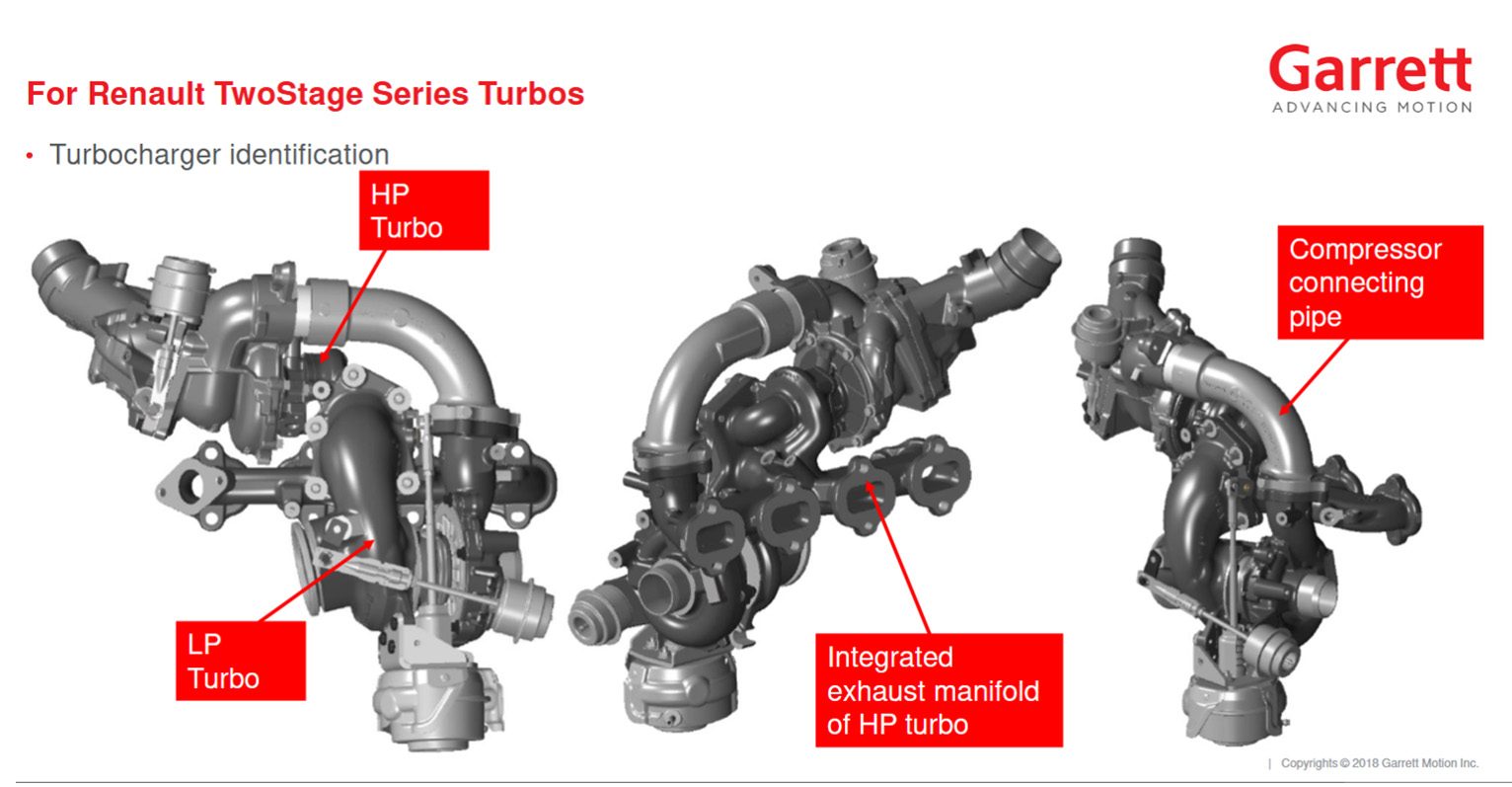
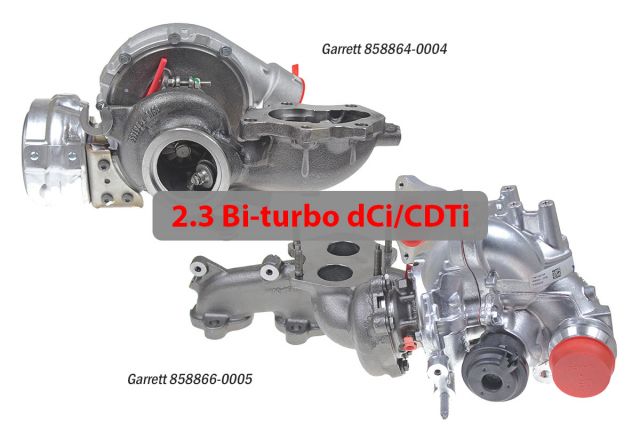
Picture Nr. 1: Complete Bi-turbo kit for 2.3 dCi / CDTi engines
The Master 2.3 BiTurbo engine uses two-stage turbocharging. The system consists of two turbochargers working sequentially. The small turbine (High Pressure) is responsible for quickly building pressure at low revs. The Big turbine (Low Pressure) takes over operation at higher loads and greater exhaust flow. Both units work together to ensure smooth torque increase and stable boost performance across the entire engine operating range.
Such a design improves the flexibility of the power unit, but increases the complexity of the entire boost system and dependence on proper exhaust flow. Failure of one component directly affects the operation of the other. These symptoms are typical of turbocharger failure in the 2.3 BiTurbo system and in practice are repeatable.
Symptoms of a damaged turbo in Master 2.3 BiTurbo
The most common symptoms include:
- power loss and underboost
- whistling during acceleration
- engine limp mode
- check engine message, boost pressure and temperature errors
- oil in the intake system
- excessive exhaust smoke
In practice, each of the above symptoms indicates a different stage of damage development.
Whistling during acceleration most often indicates developing axial play, a leak in the hot section, or wear of the turbocharger CHRA bearings.
Power loss and underboost appear when the system does not achieve the required pressure parameters, often with increased exhaust back pressure or a malfunctioning wastegate valve between the turbines.
Oil in the intake may indicate wear of the core seals, seized sealing rings, excessive exhaust pressure, or a blocked oil drain.
Exhaust smoke may indicate oil penetration into the combustion chamber or exhaust system, or a problem with fuel atomization.
In the vast majority of cases, these problems concern second-generation Garrett turbochargers used in 2.3 BiTurbo, which are more sensitive to exhaust system operating conditions and elevated temperature. Often these symptoms accompany error codes related to incorrect boost pressure.
Most common error codes for 2.3 dCi turbo failure
In the 2.3 dCi BiTurbo unit, the most common codes are:
- P0299 – boost pressure too low (underboost)
- P0234 – boost pressure exceeded (overboost)
These codes do not directly indicate damage to the turbo core, but inform about a malfunction of the entire boost system.
Garrett turbocharger generations in 2.3 dCi BiTurbo – differences, numbers and interchangeability
In 2.3 dCi BiTurbo (M9T) units used from 2010 to 2024 in Renault Master, Opel Movano and Nissan NV400, the manufacturer introduced three generations of Garrett turbochargers. The concept of two-stage turbocharging remained unchanged, but design changes affected the dynamics of operation and the system's resistance to loads. The most commonly encountered versions are those with power outputs from 136 to 190 HP.
The first generation was based on classic vacuum control valve and a more conservative cartridge design. The second generation, known among others from the 858864 + 858866 set, introduced significant modifications to both the small and large turbocharger. This is the one that most often appears in vehicles with high mileage and in analyzed fault cases.
Key changes in the second generation included:
- Modified geometry of the small turbine (High Pressure) shaft – improved speed of boost pressure building and response to load, but the rotating element became more sensitive to thermal overload and exhaust parameter fluctuations.
- Introduction of an electric actuator in the large turbine (Low Pressure) – compared to earlier vacuum control, it provides more precise boost management, but contains more elements prone to mechanical wear.
- Design modifications to the large turbocharger core – in practice, greater susceptibility to axial play development when operating at elevated temperature and under high load is observed. In the second generation, the core design changed, which increased susceptibility to axial play development at high exhaust back pressure.
Design changes in the second generation also concerned the core support elements, which further increased the system's sensitivity to axial overloads at high exhaust temperatures.
The third generation, identified among others by the 899306 + 883177 set, introduced further changes in the large turbine design. From an operational point of view, these differences are significant primarily when selecting the correct version, because individual generations are not fully interchangeable. Small turbines in practice are mutually interchangeable between generations, while large turbochargers require installation of exactly the same design version.
The second generation of Garrett turbochargers in 2.3 dCi BiTurbo provides better dynamics and faster throttle response, but shows greater susceptibility to intensive operation and elevated exhaust temperatures. Design changes improved operating parameters, but increased the dependence of boost system durability on load conditions.
Clogged DPF and turbo failure in Master 2.3 BiTurbo – damage mechanism
The DPF (Diesel Particulate Filter) and rising exhaust back pressure are of key importance.
The relationship is simple:
clogged DPF causes increased back pressure → increased exhaust temperature → bearing overload → axial play development → oil leak → turbo core damage. A similar effect occurs with a blocked catalytic converter or improper SCR system operation.
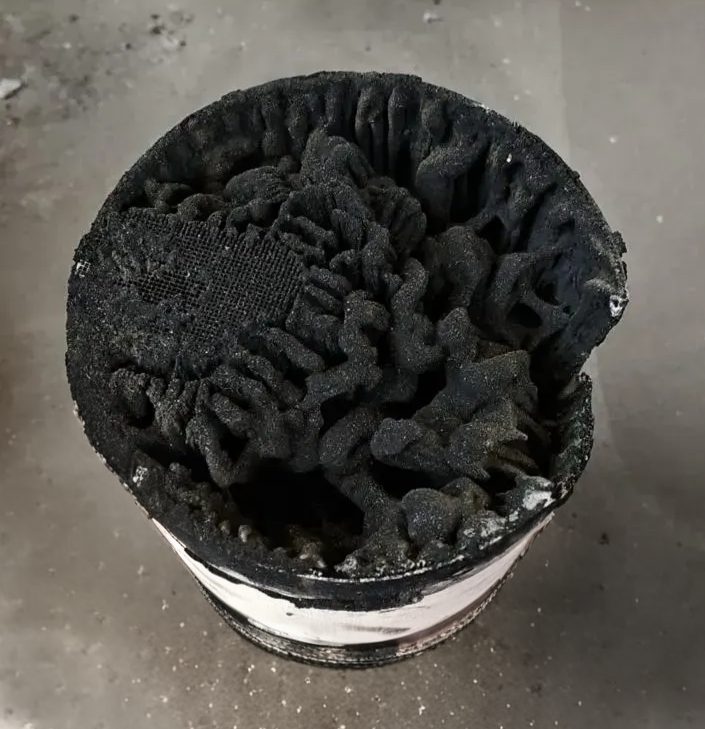
Image No. 2: Blocked DPF removed from Renault Master 2.3 dCi from a customer who inquired: "Why might the car have no power?"
High back pressure also hinders proper oil drainage from the turbo core, which further accelerates seal wear.
On short trips, the DPF does not reach regeneration temperature. Soot accumulates in the filter, and the turbocharger operates under increased pressure load. On long trips and high loads, thermal wear occurs – high exhaust temperature directly affects the turbo core and control mechanism. There are also cases of DPF structure burnout during prolonged operation under high load, which changes the nature of exhaust flow and additionally destabilizes boost operation.
An additional risk factor is improper injector operation. Incorrect fuel atomization raises exhaust temperature and accelerates degradation of rotating elements.
The large turbine (Low Pressure), which operates at greater flow and higher temperature, is most at risk. Driving with a clogged DPF leads to increasing axial play, sealing ring seizure, blade rubbing against the housing, and consequently damage to the entire BiTurbo system.
Faulty injectors and turbo overheating in 2.3 dCi BiTurbo
In 2.3 dCi BiTurbo units, injectors are a serious problem. Unburned mixture burns in the exhaust manifold, causing a sudden increase in exhaust temperature.
High temperature directly loads the turbocharger core and control mechanism. The wastegate valve seizes or its movement is restricted, and the system stops properly controlling boost pressure. This leads to overheating and overloading of the entire system. Elevated temperature can also lead to damage to exhaust manifold gaskets and deformation of control elements.
Under such conditions, even a new turbocharger will not last long. Without eliminating the injector problem, the failure will return regardless of the version used in the BiTurbo system.
How to extend turbocharger life in Master 2.3 BiTurbo Engine
Turbocharger durability in Master 2.3 BiTurbo Engine depends on controlling the entire system – not only the boost itself, but also combustion parameters and exhaust flow. The following actions have a direct impact on reducing the risk of axial play and core damage. In many cases, Master 2.3 turbo regeneration alone does not eliminate the problem if the cause of increased back pressure or system overheating has not been removed.
The cost of replacing a 2.3 dCi BiTurbo turbo is significant, so proper diagnosis of the failure cause is crucial before installing a new or regenerated component.
| Service Action | Prevents | Consequence of Neglect |
|---|---|---|
| Oil change every 10-15,000 km | Bearing wear and core overheating | Accelerated axial play and oil leak |
| DPF inspection and cleaning every 80-120,000 km | Increased back pressure and turbo overload | Core damage due to excessive temperature |
| Injector diagnostics | Increased exhaust temperature and combustion in manifold | Wastegate seizure and element deformation |
| Selection of proper turbo generation | Improper boost system operation | Recurring failures despite replacement |
The BiTurbo system is a durable design, as long as it operates under proper conditions. In these units, the turbocharger does not fail without reason – its condition always reflects the condition of the entire system.
In summary, in the Master 2.3 BiTurbo engine, turbo failure almost always results from disrupted combustion parameters or increased back pressure.
FAQ
What are the technical specifications of the 2.3 dCi BiTurbo (M9T) engine?
The 2.3 dCi BiTurbo engine with construction code M9T is a four-cylinder diesel unit with a displacement of 2298 cm³. Production of this design lasted from 2010 to 2024. Depending on the version, it develops 136, 146, 163, 170, or 190 HP. The engine was used mainly in commercial vehicles such as Renault Master, Opel Movano, and Nissan NV400.
What torque does the 2.3 dCi BiTurbo unit generate?
Depending on the power variant, the 2.3 dCi BiTurbo unit achieves torque in the range of approximately 340-450 Nm. High torque available at low revs is crucial for commercial transport and operation under load, which simultaneously affects the operating conditions of the BiTurbo system.
What emission standard does the M9T engine meet?
The M9T engine appeared in versions meeting Euro 5 and Euro 6 emission standards. Euro 6 variants were equipped with an SCR (Selective Catalytic Reduction) system and DPF filter, which directly affects exhaust temperature and turbocharger operating conditions.
Why does the turbo in Master 2.3 BiTurbo fail?
The most common cause of turbocharger failure in the 2.3 dCi BiTurbo (M9T) engine is increased exhaust back pressure caused by a clogged DPF filter or improper injector operation. Elevated exhaust temperature leads to core bearing overload, axial play development, and oil leakage into the intake system. This is most often a result of disrupted combustion and exhaust flow.
Comments
Log in to leave a comment