Turbo whistle - why, for what, what to do and where to go

20 November 2025
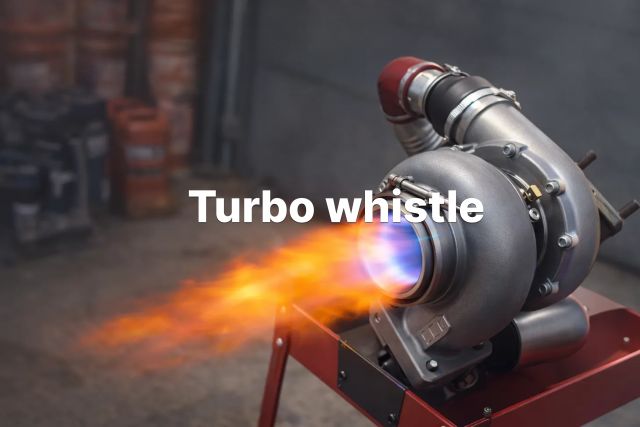
Turbo sound whistle during acceleration and under load: causes, diagnostics, and what to do
Should a Car Turbo Whistle, and What Sounds Are Considered Normal?
Turbocharger - is a component that operates at very high speeds. Depending on the engine model and turbocharger design, the rotor speed can range from 100,000 to 240,000 RPM. At such operating modes, a slight background sound is normal. Because the shaft rotates in a flow of gas and oil, working vibration is created, and the engine may produce a light, even "flow" noise. This natural sound should not be sharp, high-frequency, or change when revs increase.
Should a car turbo whistle?
- Faintly, evenly, and quietly — yes.
- Noticeably, sharply, piercingly, or "like a cricket" — no.
If the sound intensifies during acceleration, under load, at high RPMs, when gaining speed, this is already a sign of deviation, because at this moment the turbo reaches maximum boost pressure, and any leaks or vibrations manifest more strongly.
For example, on a 1.9 TDI, a light, straight turbine whistle when gaining speed may be barely noticeable, and this is normal air compression. But if the same engine starts to "squeal" at 2000-2500 RPM or the turbo howls during acceleration, this almost always indicates an air leak in the intake or initial play in the cartridge.
How to Distinguish Sound Characteristics
| Sound | How It Feels | What It Usually Means |
|---|---|---|
| Even, soft, more hissing than whistling | doesn't change tone sharply, heard in background | normal turbocharger operation |
| Sharp and loud turbo whistle sound during acceleration | manifests under load | air leak in intake / intercooler crack |
| Rumble / turbo howl | sound becomes dense, low-frequency | overload or resistance in exhaust |
| Squeal / "cricket" | sound thin, trembling | vibration or cartridge imbalance |
Why Is Turbo Whistling Under Load and During Acceleration Heard More Often?
When pressing the gas, the turbocharger quickly increases revs and boost pressure rises (gasoline 1.5-3.5(4) bar, diesel 1.2-2.5 bar). The higher the pressure and stronger the gas flow, the more noticeable any micro-leaks become. Therefore, turbo howling during acceleration or under load is heard more distinctly.
What actually happens:
- Boost tract (intake after turbo). Compressed air passes through hoses, intercooler, and intake manifold. If there's a micro-crack, loose clamp, or hose rupture, a "nozzle" forms at the leak point. In it, flow velocity increases locally, and a characteristic thin whistle appears, which intensifies with boost pressure and disappears when throttle is released. Often such a leak is accompanied by MAF/MAP error codes, because sensors detect a discrepancy between target and actual pressure.
- Exhaust tract before turbo (exhaust manifold). If a gasket burns through or a crack appears in the exhaust manifold, exhaust gases break out under pressure, the sound becomes a low, dense howl, especially noticeable during acceleration. If increased back pressure is simultaneously present (clogged DPF or catalytic converter), shaft spin-up slows down, and the rumble intensifies. Such a leak is often accompanied by codes P0130/P0133/P0134 (lambda sensor) or P0420/P0430 (catalyst efficiency).
- Turbo whistles in a narrow RPM range. If the sound manifests only, for example, at 2000-2500 RPM and disappears in ranges above and below, this is a characteristic sign of cartridge imbalance or increased shaft play. We'll discuss this in more detail further on.
Turbo Whistling at Low RPMs
When you hear something like turbo whistles at idle, or a brief "squeak" occurs when starting to move, in 80% of cases the cause is intake leak. The transition from idle to pulling gives a pressure impulse, and a characteristic sound appears through the micro-crack. This problem is often encountered in Passat B6 2.0 TDI, Ford Focus 1.8 TDCi. With a burst hose/intercooler, they behave quietly under steady pull, but turbo whistling when gaining speed begins to manifest especially actively.
If the sound grows with pressure and disappears when it drops, in most cases this is external leakage in the intake or exhaust tract, not the turbo itself.
Turbo Whistling When Releasing Throttle
If the sound appears after releasing the pedal, the cause almost always remains in the intake. The air flow changes direction and passes through the same micro-crack, but in the opposite direction, so the car turbine whistle becomes shorter and sharper, like a "shot."
Turbo Howls When Cold
The first 5-30 seconds after startup, oil is just reaching working pressure and stabilizing the turbo shaft. If the sound disappears after warm-up, this is not a turbo malfunction. If the turbocharger whistle remains after warm-up, this is already an intake or exhaust tract leak, and another cause needs to be found.
Whistling in the Turbo Itself: Causes - Play and Cartridge Balancing
When the source of whistling is in the turbo itself, not in the intake or exhaust, you need to work with the cartridge. If due to bearing group wear or poor balancing the cartridge shaft operates with slight deviation, vibration occurs. At low RPMs it's unnoticeable, but when the turbo enters its operating range, the shaft rotation frequency coincides with the component's natural resonance frequency, and a characteristic thin whistle or turbocharger squeal appears. This is exactly why the car turbo whistle when accelerating or under load and most often in the same speed range. Here the sound doesn't "wander" and doesn't disappear randomly, a clear pattern is observed.
When RPMs rise above the resonance zone, the sound weakens, when lower — it also disappears. If turbo charger whistle becomes sharper, repetitive, or you get the feeling that the sound "trembles," this is a sign of increasing cartridge play and intensifying vibration. If you don't react in time, there's a risk that at some point the shaft&wheel will start touching the housing, and then the acoustic accompaniment is replaced by mechanical destruction of the cartridge.
Cartridge bearing wear → slight shaft play → shaft vibration → turbo rumble in resonance state
At an early stage, this is just a high sound, at a later stage there's a change in the geometry of the working pair and cartridge failure. If the sound consistently repeats in the same speed range, this is a sign of shaft rotation trajectory imbalance. The cartridge needs to be diagnosed and balanced while there's no mechanical damage yet.
Why Does a Turbo Whistle on Diesel During Acceleration?
On diesel engines, the turbo reaches working pressure already at 1500-1800 RPM, meaning that in case of leaks or play, the sound becomes noticeable earlier than on gasoline. The reason is not that the turbo "works louder," but in the characteristics of the engine itself. Normally, diesel boost works almost silently, so a persistent turbo whistle on diesel is a deviation.
Examples of Typical Situations:
1.9 TDI (VAG) — light, even noise during acceleration is normal. If at 2000-2500 RPM a thin, piercing turbo charger whistle appears, most often a damaged hose or intercooler is to blame.
In 2.0 TDI (VAG) engines, a dense “howling” car turbo sound whistle under load usually indicates increased exhaust back pressure (DPF or catalytic converter restriction) or a cracked exhaust manifold.
Therefore, remember that diesel turbo doesn't whistle "by definition." If there's a rumble, it always has a cause.
Turbo Whistling: Sound After Repair, Replacement, or Regeneration
If a whistle appears after turbocharger replacement, most often the cause lies in installation quality or assembly specifics. Because under thermal and mechanical loads, the turbo requires perfect alignment and sealing.
Why This Happens:
Leaky installation. Even minimal flange misalignment or uneven gasket compression creates a gap through which air or exhaust passes under pressure, causing whistling. When heated, metal expands, and whistling sound from turbo may change — this is a typical sign of thermal deformation of connections.
Violation of torque specifications. If bolts are tightened unevenly or old gaskets are reused, after several heating and cooling cycles a leak appears at the joint, causing the turbo to howl or "squeal."
Cartridge hasn't undergone precise balancing. Even a new or remanufactured turbo can whistle if the rotor isn't brought into precise balance. Here, it's important how accurately the manufacturer observes tolerances.
Short-term oil starvation due to clogged oil channels or overheated, contaminated oil accelerates bushing wear and increases imbalance, which manifests as narrow-band whistling in one RPM range.
What to Know About Cartridge Balancing from Different Manufacturers
We compared the production process standard characteristics of the two most well-known European brands producing aftermarket parts. Both companies are recognized in the EU but differ in tolerance requirements.
| Manufacturer | Cartridge Balancing | Result in Operation |
|---|---|---|
| Melett (standardized OEM-class tolerances) | Parts undergo inspection, slightly higher vibration level is allowed within standards | This is not a defect, but in some systems whistling may be more noticeable, especially on diesels with high boost "from below" |
| Turbocentras (balancing close to zero deviation) | Cartridges are brought to the minimum possible vibration level across the entire working zone, not just at a control point | Less whistling, stable operation without "resonance window," greater service life under load |
As we can see, Melett allows a standard vibration level sufficient for operation, while Turbocentras aims for the minimum possible deviation, i.e., practically zero imbalance of shaft and impeller. Before final balancing, each assembled cartridge is additionally checked for assembly quality and connection rigidity, then installed on a high-speed balancing stand. Testing is performed across the full operating RPM range, at a temperature of 30-45°C, and pressure can reach 1.8-5 bar, meaning conditions as close as possible to actual turbocharger operation. If vibrations exceed acceptable limits, point correction is performed, milling the shaft or impeller in a specific micro-zone. This way, the company achieves smooth cartridge operation at all RPMs, eliminates resonance zones, and ensures compliance with OEM standards.
The Wiatreo online store is the official representative of the Lithuanian company Turbocentras in Poland. We perform turbocharger regeneration based on this manufacturer's technical capabilities. As a rule, after installing such turbos, whistling is extremely rare, and the component's service life and stability are higher.
What Happens If the Turbo Stopped Whistling on Its Own?
If turbo whistling intensifies, it means vibration and play are growing. At a certain stage, the shaft starts touching the housing, compressor wheel or turbine wheel blades can break off, and their fragments can get into the intake and then into cylinders. This is no longer an acoustic trigger but direct engine destruction. Therefore, a situation where "the turbo stopped whistling on its own" almost always means not a fix but that the cartridge has already been destroyed and the turbocharger has stopped creating the necessary pressure.
How to Diagnose Turbo Whistling?
Wiatreo company is thoroughly familiar with this problem. And our team is ready to share experience on how to determine the cause of turbo whistling using simple improvised methods.
Checking Intake Seal with Smoke Test
Light colored smoke is fed through the air supply system (after the filter). If there's a micro-crack, loose clamp, or damaged hose somewhere, smoke will definitely come out there. This is the best way to find a leak causing turbo whistling during acceleration.
Inspecting Exhaust Tract for Cracks
The exhaust manifold and gaskets should be inspected for dark carbon deposits or soot traces. These are signs of gas breakthrough. For additional verification, you can slightly moisten connection points with soapy solution. With the engine running, if sealing is compromised, bubbles will start appearing.
Checking Turbo Shaft Play
After removing the hose, assess axial and radial play in the cartridge. Slight movement within the oil film is acceptable, but if the shaft noticeably moves and makes a metallic sound, the cartridge requires diagnosis and balancing.
How to Prevent Turbo Whistling: Wiatreo Recommendations
For the turbocharger to work quietly and stably, not only its design is important but also operating conditions. Everything comes down to simple things:
- Change engine oil more often than specified in the schedule. If the manufacturer recommends every 10,000 km, change it once every 7-8 thousand, so the oil film remains stable and there's no threat of bushing and shaft wear.
- Monitor intake seal. Any small crack in a hose or intercooler over time turns into whistling, and later — into pressure loss and cartridge service life reduction.
- Don't shut off the engine immediately after load. After highway or active driving, let the engine idle for 30-60 seconds to stabilize temperature and preserve bearings.
- If you have a diesel, periodically "blow out" the geometry. Once every few trips, raise RPMs to 3000-3500 RPM to shed carbon deposits, reduce the likelihood of geometry seizure and increased system pressure.
These tips don't cure turbo whistling, they simply prevent its appearance, i.e., extend turbocharger service life to standard and beyond.
Comments
Log in to leave a comment