Electronic actuator - Symptoms of turbine damage. Errors and types of actuator damage

26 February 2025
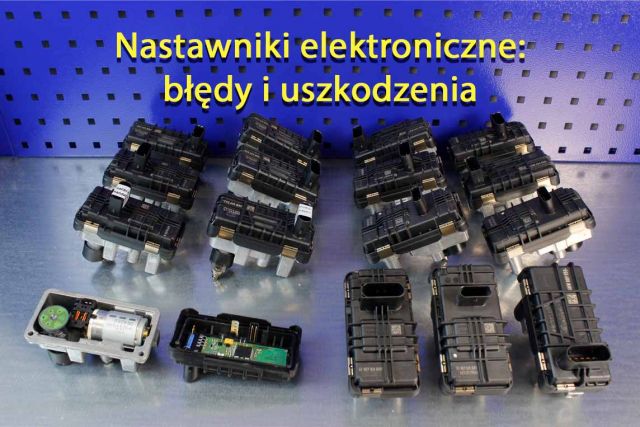
A faulty turbo actuator cannot always be identified from a boost pressure error or a change in engine power alone. Similar symptoms also occur with a working electronic actuator if the turbocharger control mechanism linked to it is sticking.
Before repair or replacement, it is established whether the actuator receives a command from the engine control unit, whether it reaches the target position and whether it can hold it. The mechanical part of the control system is checked separately. Wiatreo specialises in turbochargers and their components and is the official representative of TURBOCENTRAS UAB in Poland. This article is based on specialist technical information on boost systems and their components.
Symptoms of a faulty turbo actuator
A faulty actuator usually shows up as a change in boost pressure and in how the engine behaves under load. The nature of the symptoms depends on whether the actuator carries out the command and what position the linked VTG/VNT or wastegate mechanism is in. In practice, it most often looks like this:
- Loss of power under load. If the actuator-controlled wastegate valve is stuck open, part of the exhaust gas bypasses the turbine wheel, so the turbocharger does not build the required boost pressure.
- Overboost and limp mode. If the control mechanism is stuck closed, the actual boost pressure can exceed the target, after which the control unit puts the engine into limp mode.
- Jerking under acceleration and unstable boost. This happens when the actuator does not hold the target position and the position of the control mechanism changes during operation.
- Excessive play in the actuator lever. It can lead to incorrect positioning of the variable geometry and a deviation of boost pressure from the target value. The source of the play itself is determined separately, as it is not always inside the actuator.
- Boost pressure errors. The control unit records a discrepancy between the target and actual pressure. Such a discrepancy alone does not show whether the fault lies in the actuator or in the mechanical part of the turbocharger.
- The actuator does not respond during diagnostics. If the turbo actuator is not working, it does not carry out the control unit’s command. In some cases the turbo actuator rod does not move either.
These symptoms point to a boost control problem, but the source of the fault can only be established after checking the actuator itself and the mechanism linked to it.
What most often fails and wears out in an electronic actuator?
HELLA electronic actuators have been produced in several generations. The first generation was developed using “space technology”. Its design used a ceramic microprocessor able to work reliably at temperatures from -100 to +150 °C. It was a project from before the crisis in the automotive industry, when engineers could use expensive technical solutions without such strict cost limits. The design has stood the test of time, and some of these actuators have been working in cars for more than ten years.
The mechanical components proved weaker than the electronics. Their wear is often the cause of a turbo actuator fault. The parts that wear most often are the worm gear, the position sensor potentiometer and the electric motor. In the worm gear and potentiometer, HELLA uses a special graphite-filled plastic that reduces friction between the contacting parts. Over time, this material wears out too. When repairing some actuators, the bearings may also need replacing.
After the crisis, the design was optimised for cost and the production process. The electronics became simpler, while the mechanical part changed much less. Design solutions introduced back in the 2000s are still used in newer cars.
The contacts on the electronic board fail much less often than the mechanical parts, but such a failure can completely disable the servo drive or make it work erratically. In the original design, such damage is caused by harsh operating conditions and constant vibration. Water getting inside the housing and oxidised connector contacts can also cause failure.
How to test a turbo actuator
The test method depends on the type of actuator and control system. Diagnostics of an electronic actuator start with reading the fault codes and current parameters of the engine control unit. An initial check of the actuator can be done without removing it. A diagnostic tool is used to run an actuator test, watching whether the actuator responds to the command, whether the rod or lever moves and whether the actuator reaches the target position.
Next, the actuator position, boost pressure and condition of the electrical part are compared:
- Target and actual actuator position are compared. If the actuator moves but does not reach or hold the required position, the actuator itself and the mechanical resistance of the linked mechanism are checked.
- Target and actual boost pressure are compared. The discrepancy is assessed together with the actuator position, as on its own it does not prove a turbo actuator fault.
- The connector, contacts and wiring are checked. Oxidised contacts can disrupt the position sensor signal and cause control errors. If the actuator does not respond at all, its electronics are also checked. Such a failure is possible after water gets into the housing or the electronic board is damaged.
- The electric motor is checked. As it wears, its current draw increases. The resistance of metals changes with temperature, so this test is more informative with the actuator heated to about 60–80 °C or more. The readings will then be closer to the actuator’s working conditions on a running engine.
How to tell an actuator fault from a VTG/VNT or wastegate fault
If the electronic actuator receives the command but the rod or lever does not complete the required travel, you need to find where the resistance comes from. The cause may be the actuator itself or a coked-up or sticking VTG/VNT or wastegate mechanism. HELLA TechWorld also recommends treating the actuator and the mechanical part of the turbocharger as a single unit during diagnostics.
The source of play is checked separately. Play inside the actuator gearbox comes from wear of its mechanical parts. If the play is in the wastegate arm, the cause may be a worn flap bushing in the turbine housing. Repairing or replacing the actuator will not fix this defect.
Mechanism and actuator faults can occur at the same time. Melett points out that VNT sticking increases the load on the actuator’s electric motor and worm gear and can damage them over time. So when movement is stiff, both the control mechanism and the actuator itself are checked.
How an electronic actuator is repaired and when repair is possible
Repair begins once the fault has been traced to the actuator itself. HELLA electronic actuators are the easiest to recondition.
After disassembly, the electric motor, worm gearbox, position sensor potentiometer and bearings are assessed. Worn parts are replaced. The electronic board is not normally a standard replacement part, so whether a damaged board can be repaired depends on the specific actuator model.
When replacing the motor and worm gear, their gear ratio and compatibility with the specific actuator version are taken into account. Similar-looking parts may differ in gearbox design and calibration parameters, so they cannot be considered interchangeable based on shape or size alone.
After assembly, the actuator is tested on specialist testers and programmers. When reconditioning turbochargers, we use TurboControl, G3 REA-MASTER and Deltatech VNTT-PRO. We check the full actuator travel, start and end positions, position sensor signal, gearbox play and electric motor current draw. If needed, we adjust the actuator parameters and calibrate its range of motion.
After fitting the actuator to a VNT/VGT turbocharger, we set the geometry and match the actuator’s operating range. We describe variable geometry setting parameters and the capabilities of the GEOMET-2000 test bench in a separate article.
When can an actuator not be repaired?
Some models cannot be repaired, or repair is not technically worthwhile. The main limitations are:
- Non-serviceable housing. On some models, the gearbox and other internal parts can only be reached by damaging the housing. There are ways to open such actuators, but they make the repair much more complicated.
- No repair parts available. For new or rare models, suitable motors, worm gear parts, position sensors and other components may not be sold separately.
- Damage to electronics that cannot be reconditioned separately. In some electronic actuators, the board and the calibration data stored on it are tied to a specific actuator and turbocharger. If such a module cannot be repaired or replaced separately, the whole actuator is replaced.
- Severe damage to the housing or connector. After an impact, crack or breakage of the housing, its mechanical integrity and sealing cannot always be restored. In such cases, the actuator is also replaced as a complete unit.
Vacuum and vacuum-electronic actuators are usually also replaced as a whole. Their design is simpler, the actuator itself is relatively inexpensive, and repair parts for these models are practically unavailable on the market.
Repair or buy a new aftermarket replacement?
For some types of actuators, aftermarket replacements are perfectly acceptable. Our position is based on our own actuator tests and customer feedback after long-term use.
For HELLA actuators with a worm gear, we do not recommend an aftermarket replacement. Our position is based on three practical observations:
- The internal parts of the actuator differ from the original. Such an actuator cannot be repaired.
- Poor quality of the worm gear plastic. Such a turbo control valve will work effectively for 3–6 months (depending on driving style and operating conditions). After that, they fail due to excessive play.
- Use of grease in worm gears. Contrary to appearances, lubricants make the worm gear wear out faster.
Comments
Log in to leave a comment